How eDEM-CONNECT Helps with Optimal UX Design

Ella Carini
Ella CariniAuthor
Alina Dier
Alina DierAuthor
Christoph Rosemeier
Christoph RosemeierAuthor
Reading time
5 Minutes
Published
26. Juni 2025
Topics
UX Design

Digital relief for family caregivers

Around 1.8 million people live with dementia in Germany [source]. With approximately 445,000 new cases each year, this number is steadily increasing. The majority of these individuals are cared for at home by family members — a task that is emotionally demanding, time-consuming, and full of challenges [source]. 

This is precisely where the research project eDEM-CONNECT, funded by the Federal Ministry of Education and Research (Bundesministerium für Bildung und Forschung), comes in: it aims to support family caregivers with a digital platform. Ergosign was involved as the UX partner in this project and demonstrates how human-centered design can concretely help in challenging life situations.

Putting individual care at the heart of digital design

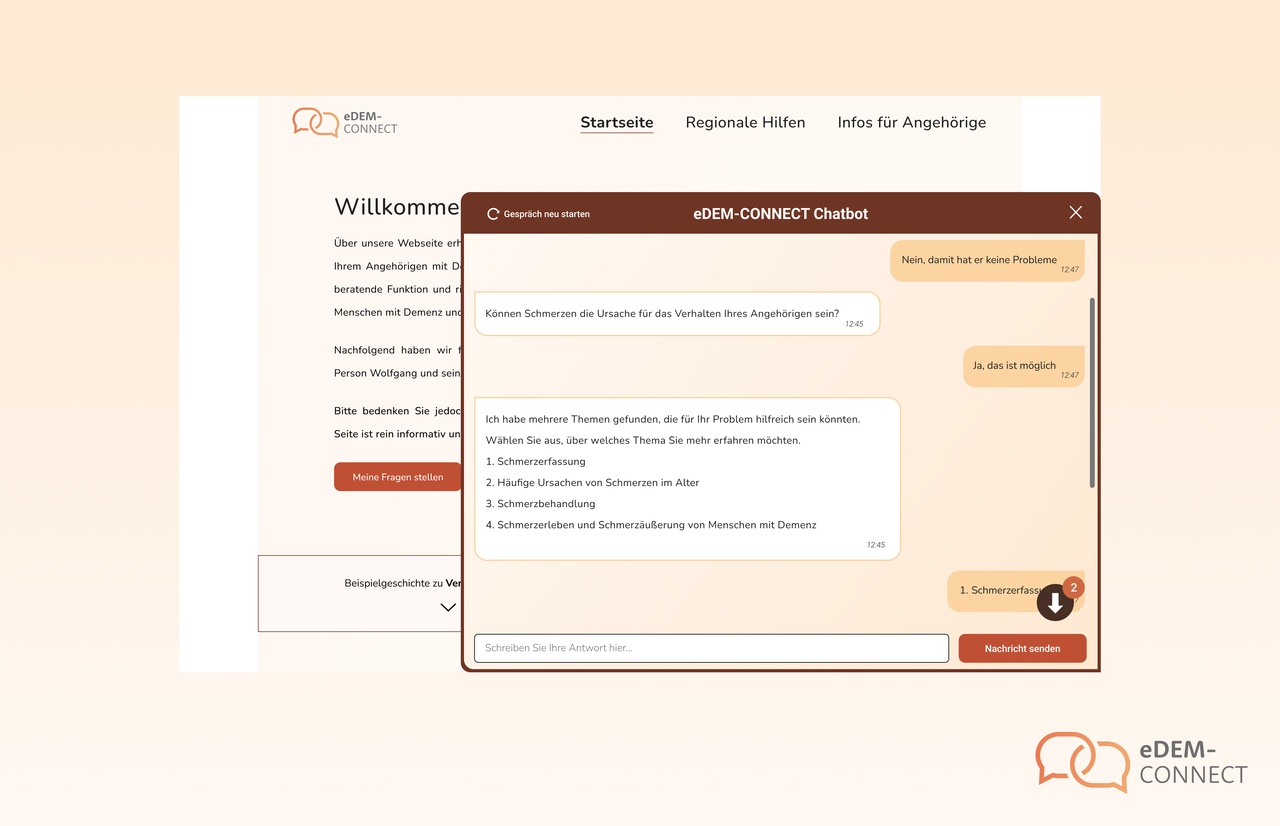
The eDEM-CONNECT platform offers three core functions: a chatbot for individual questions, a practice-oriented knowledge portal, and a search function for regional support services. The idea is that family caregivers should be able to find information and assistance easily and based on their needs — especially for behavioral issues such as restlessness or aggression.

While the chatbot enables caregivers to get answers to individual questions, the knowledge portal provides practical information in the form of articles. Through the search function, caregivers can quickly find appropriate support services such as day care, care groups, or self-help groups — for both people with dementia and themselves.
UX at the core

Empathize, create, validate

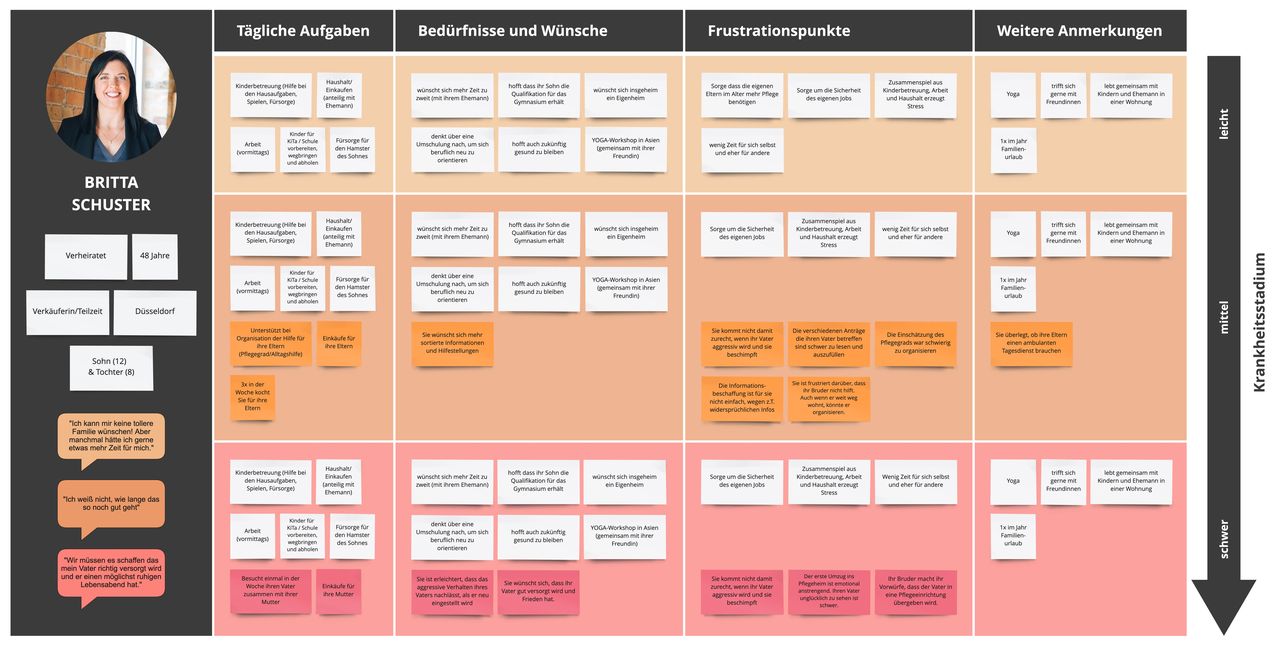
Ergosign took responsibility for UX design, research, prototyping, visual design, and testing in the project. Our approach: only those who understand the target group can create a truly helpful application. Therefore, we analyzed interviews with family caregivers and created validated personas based on these — including, for example, Britta (see illustration), who cares for her father with dementia. These personas gave us deep insights into individual life realities and caregiving challenges.

From caregiving journey to tested prototype

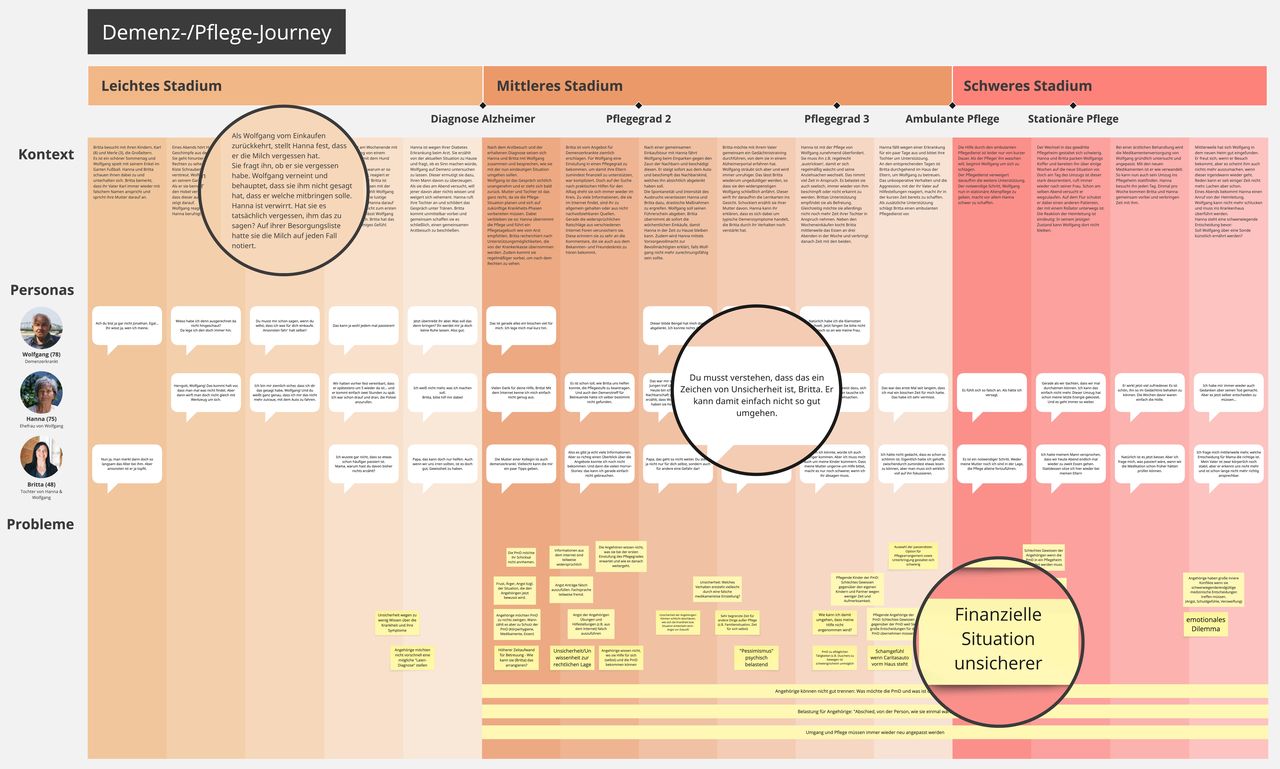
Using the personas, we developed a care journey to capture the changing needs over the course of the illness. It maps typical stress points and information requirements along the different stages of dementia — from the initial diagnosis to advanced care dependency. This structured perspective helped us derive targeted UX measures — such as intuitive navigation, appropriate content for specific phases, or quick access to regional support services.

The result was a prototype specifically tailored to the needs of the older target group — inclusive design was an integral part from the beginning. Since many users have age-related impairments like visual weaknesses, we placed special emphasis on clear contrasts, easily readable fonts, generous controls, and intuitive navigation. To continuously improve usability and user experience, the prototype was tested in two iterations with the target group. The collected feedback was directly incorporated into further development — resulting in an application concept that truly meets the everyday needs of family caregivers and people with dementia.

Emotions meet ethics

Tactful design 

Caring for a person with dementia is associated with many emotions. This emotional aspect was incorporated into all phases of the concept. In workshops at the Evangelical University of Nuremberg, ethical questions were discussed, such as: How much can a chatbot do? Where is human support needed? Our design approach therefore focused on building trust. A warm color scheme, clear language, and relatable examples are intended to facilitate access.

Chatbot mit Verantwortung

Besonderes Augenmerk lag auf der Entwicklung des Chatbots. Zwar bietet er niedrigschwellige Hilfe, stößt aber bei emotionalen Themen an Grenzen. Die Usability Tests zeigten: viele Nutzer:innen sind skeptisch und wünschen sich bei heiklen Fragen menschliche Unterstützung. Unsere Erkenntnis: digitale Tools müssen die Bedürfnisse der Zielgruppe nicht nur technisch, sondern auch ethisch ernst nehmen. Eine mögliche Weiterentwicklung ist daher eine gezielte Übergabe an professionelle Beratungsstellen.

Conclusion

UX design as a bridge to better quality of life

eDEM-CONNECT shows how UX and inclusive design can be used deliberately to create digital solutions for sensitive and complex life situations. The platform was designed to intuitively, accessibly, and emotionally support family caregivers of people with dementia. Through comprehensive research, iterative usability testing, and mindful handling of the topic of dementia, a prototype was created that convinces both functionally and empathetically. With a clear information structure, legible typography, high contrast, and simple navigation, eDEM-CONNECT is an example of how human-centered design in healthcare can deliver more than just attractive interfaces — it can provide real added value in everyday life.

Note: This project was funded by the Federal Ministry of Education and Research (Bundesministerium für Bildung und Forschung) under grant number 16SV8338. The authors are responsible for the content of this publication.

Relevant Insights & News

Go to more news and insights